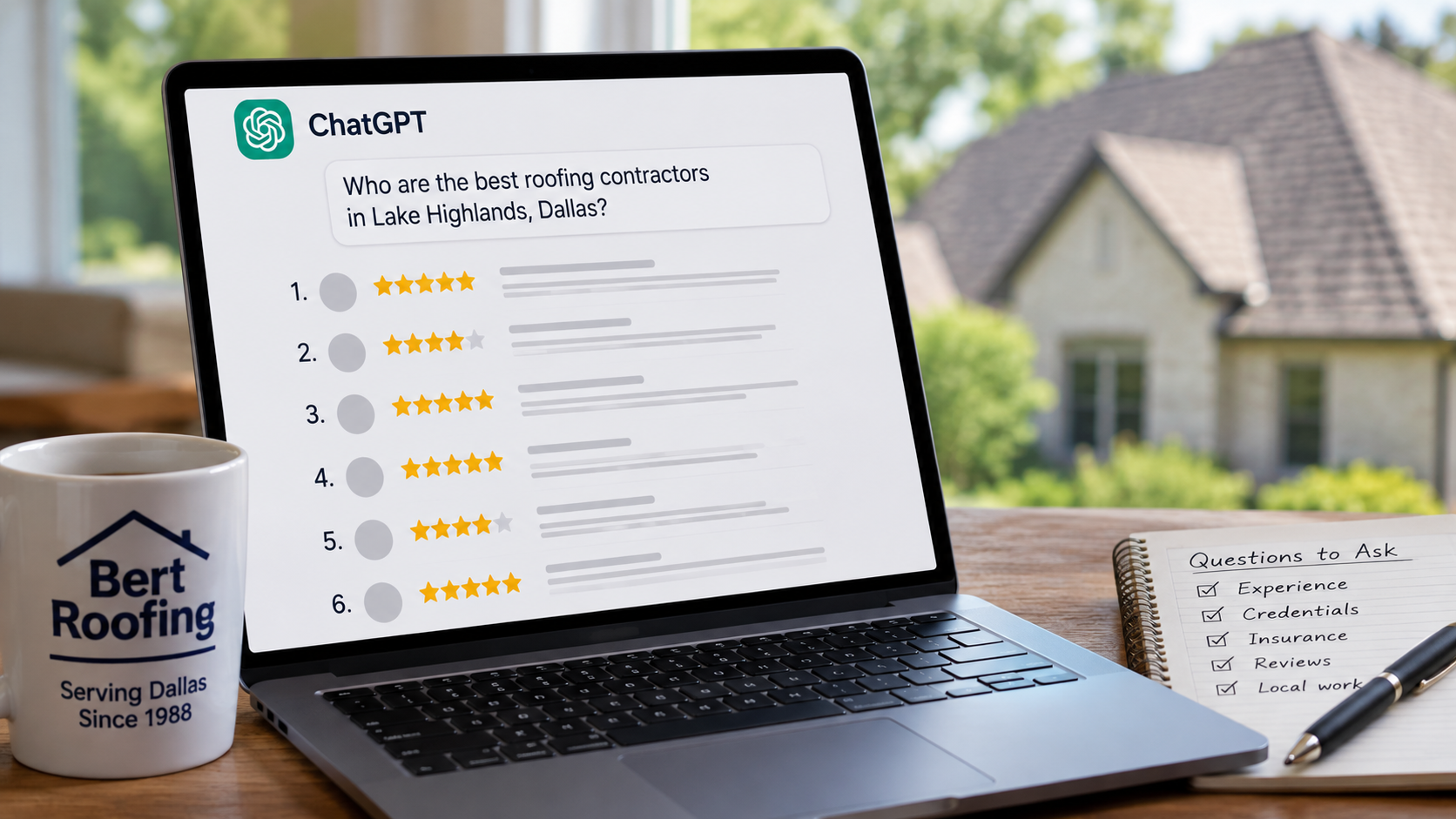
More homeowners are turning to artificial intelligence to help them make purchasing decisions. Instead of searching Google and visiting dozens of websites, they can simply ask ChatGPT to recommend the best roofing contractors in their neighborhood.
Within seconds, they may receive a ranked list of companies, complete with explanations, reviews, credentials, and links to supporting information.
It certainly sounds helpful. But how much research went into those recommendations? And what important information might have been overlooked?
I’ve spent decades in the Dallas roofing business, and I was curious about how AI makes these decisions. So I decided to run a small experiment.
I Asked ChatGPT the Same Question Three Times
I created a separate, anonymous ChatGPT project without my personal background or previous discussions about my roofing company. I wanted to see what someone unfamiliar with the roofing industry might receive.
I asked ChatGPT to recommend the six best residential roofing contractors in four Dallas neighborhoods: East Dallas, Lake Highlands, Lakewood, and Casa Linda.
I repeated the exact same question in three new conversations. The only difference was the thinking setting: Instant, Medium, and High.
The results surprised me.
In the first test, one contractor ranked first in all four neighborhoods. Under Medium thinking, the top recommendation changed in one neighborhood. Under High thinking, three of the four original first-place recommendations changed.
There was another interesting difference. The High response settled on the same six contractors for all four neighborhoods, changing their order depending on the location. The faster responses drew from a larger collection of companies.
The explanations changed as well. The more detailed responses placed greater emphasis on documented projects, manufacturer credentials, technical experience, and, in one instance, specific customer complaints.
Does this prove that higher thinking settings produce better recommendations? No.
AI responses can vary even when the same question is repeated under identical conditions. This was a small informal experiment, not a controlled study. I also wasn’t evaluating the actual workmanship of the companies involved.
But it demonstrated something worth understanding: The same homeowner can ask the same AI system the same question and receive substantially different recommendations.
That made me curious about what information AI was actually using to make those decisions.
What AI Can See and What It Can’t
AI can gather a considerable amount of information about a roofing contractor from its online presence.
Google reviews, Yelp ratings, Better Business Bureau records, company websites, manufacturer certifications, published projects, years in business, and office locations are all relatively accessible.
Some of this information is valuable. A manufacturer certification that can be independently verified means something. So does documentation of completed projects using the same roofing materials a homeowner is considering.
But there is a difference between information that is easy to find and information that is most important.
A contractor might have an excellent website and hundreds of positive reviews. That doesn’t necessarily tell us whether its crews install flashing correctly, how the company handles a leak several years later, or whether it consistently follows appropriate business practices.
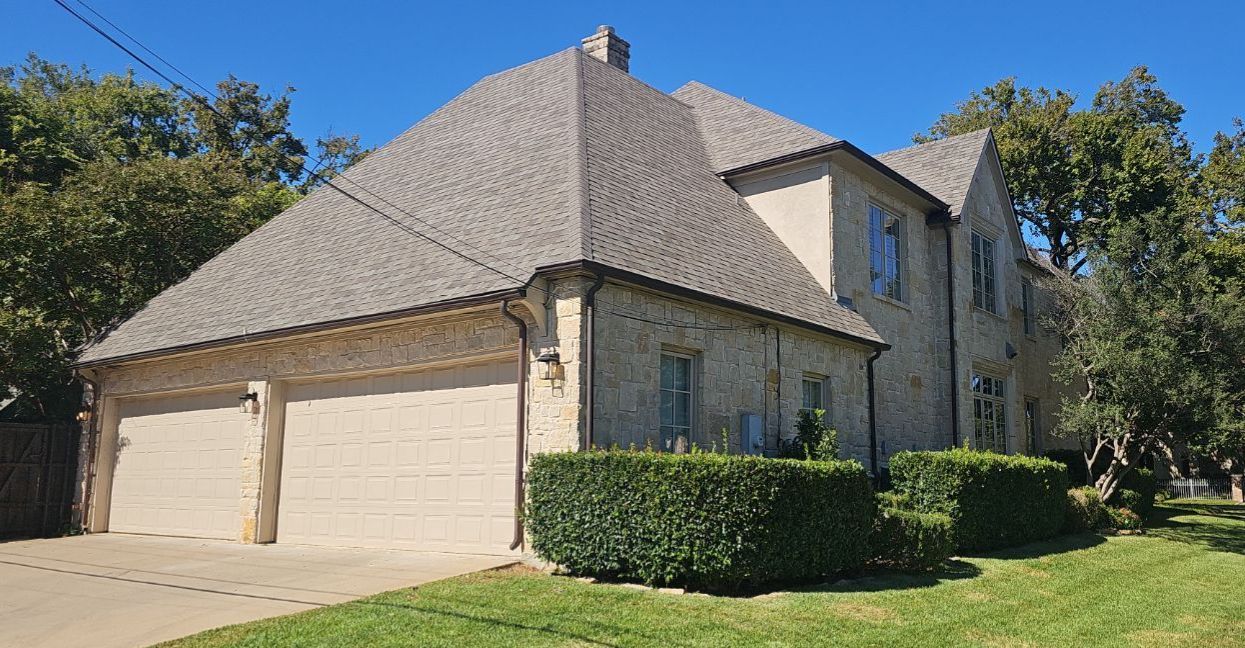
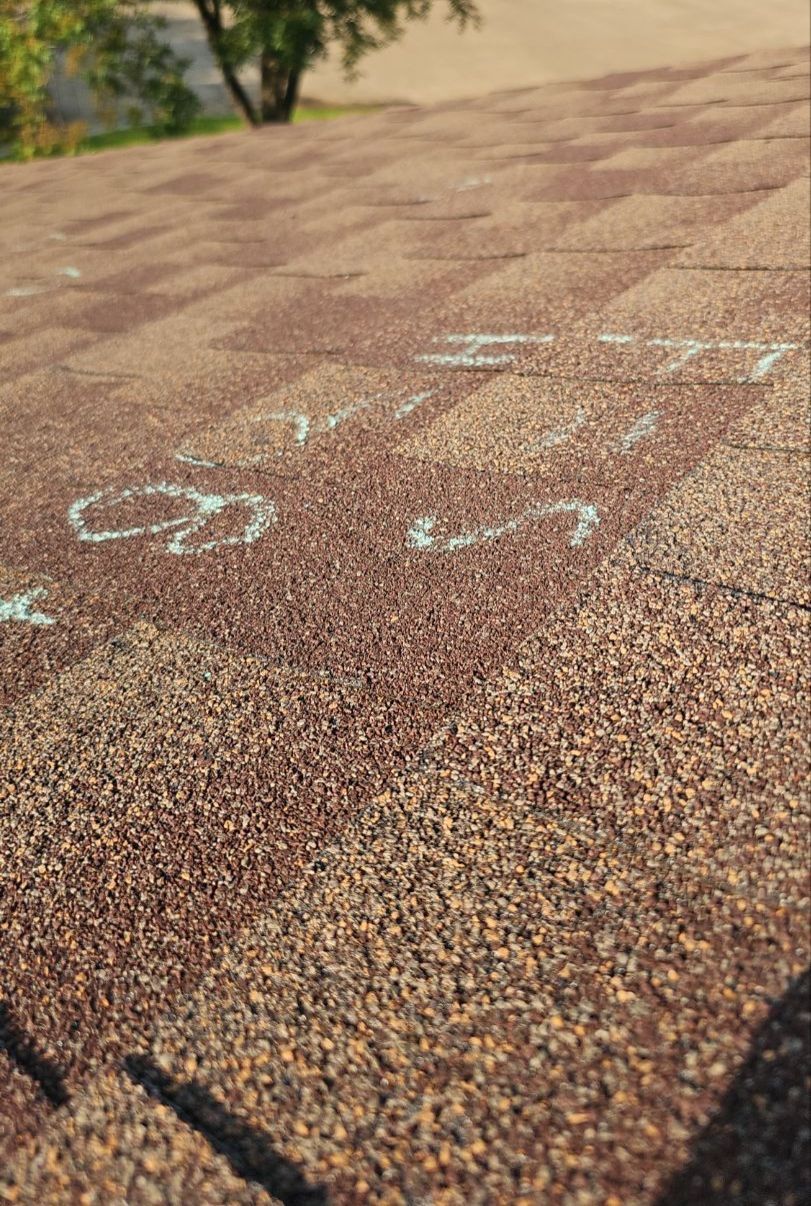
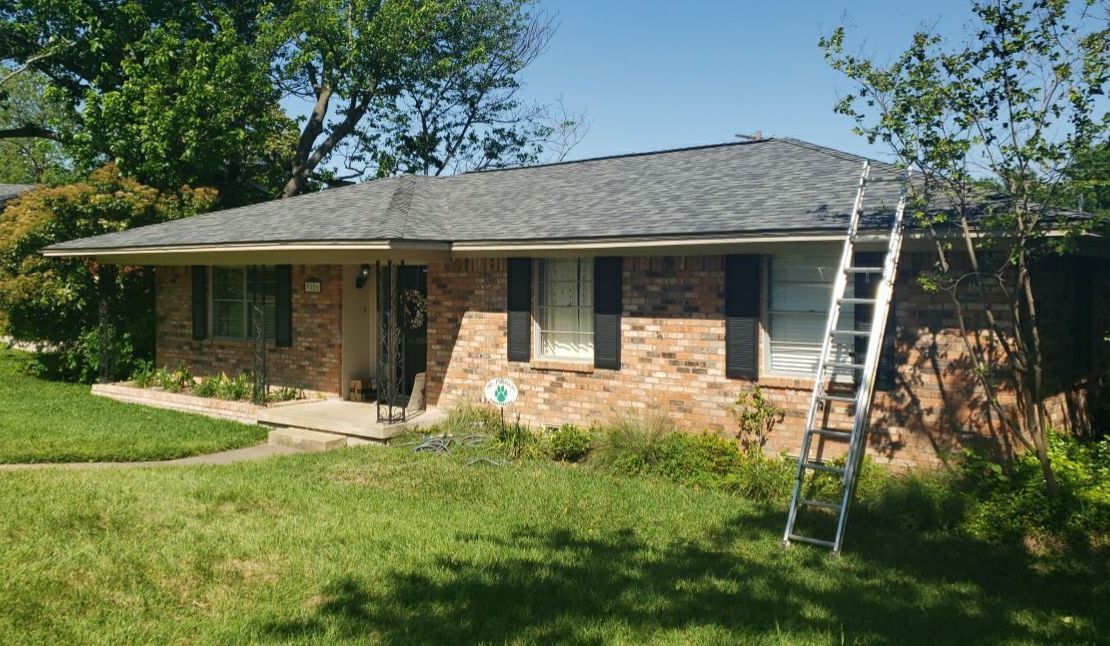
For example, this Lakewood roof replacement documents different roofing materials, decking repairs, and installation details that wouldn’t be apparent from a star rating.
And while AI can investigate many of these questions, a homeowner who simply asks for the “best roofers near me” may not be prompting it to look beyond readily available reputation signals.
What a Five-Star Average Really Tells You
Online reviews are useful. Most established roofing contractors receive plenty of five-star reviews, and deservedly so. Satisfied customers frequently take the time to share their experiences.
What makes me somewhat skeptical is a perfect 5.0-star average, particularly when a company has accumulated hundreds of reviews.
Roofing is a complicated business. Even good contractors occasionally encounter dissatisfied customers, scheduling problems, communication issues, or disagreements over completed work.
A displayed five-star average doesn’t prove anything improper. Ratings can also be rounded, so a displayed 5.0 doesn’t necessarily mean every customer awarded five stars.
Nevertheless, a perfect average across a large number of reviews makes me want to look more closely at how those reviews were accumulated and how representative they are of the company’s overall customer experience.
Consider two roofing contractors.
One has operated for decades, completed thousands of roofs, and accumulated a relatively modest number of Google reviews.
Another has been operating for a shorter period but has several hundred reviews and a perfect five-star average.
Which one is the better contractor?
We really don’t know.
A contractor that routinely encourages customers to leave Google reviews may accumulate them considerably faster than one that rarely asks. That doesn’t make the reviews dishonest. It simply means review volume measures more than workmanship and customer satisfaction.
The content of the reviews matters, too.
“Great job, would use again” may be completely sincere. But it offers little information about the quality of the installation, the materials used, or how the contractor responds when a problem develops later.
I place more value on detailed reviews describing the actual work, communication during the project, and how problems were handled.
There is also the potential for manipulation.
Financial incentives can influence customer reviews. A single roofing customer might submit reviews on Google, Yelp, the BBB, and several other platforms. One experience can therefore appear across multiple review sites.
There is nothing inherently wrong with a customer reviewing a business on more than one platform. But providing money, discounts, or other benefits in exchange for reviews raises a different issue.
Google prohibits incentivized reviews, and Yelp also prohibits review incentives.
That doesn’t mean every company with hundreds of five-star reviews has manipulated them. It means a large review count shouldn’t automatically outweigh more substantive evidence about the contractor.
Our guide to roofing scams and sales tricks explains other practices homeowners should recognize before hiring a contractor.
Yelp and the Problem of Small Samples
Yelp adds another complication.
For many years, Yelp was more closely associated with restaurants, bars, salons, and other businesses consumers visit regularly. Roofing contractors haven’t traditionally attracted the same volume of Yelp reviews.
Consequently, a contractor with decades of experience and thousands of completed projects might have relatively few reviews on the platform.
When the sample is small, one or two unfavorable reviews can significantly affect the average rating.
And not every negative review represents a problem with completed roofing work.
For example, a major rainstorm can generate more requests for roofing service in a few days than a contractor can reasonably handle. A homeowner who cannot get an appointment may leave a negative review even though the company never performed any roofing work.
That customer’s frustration may be legitimate. Responsiveness is part of customer service. But an inability to accept additional work isn’t the same as defective workmanship.
AI needs to recognize that distinction when evaluating contractors.
Yelp also uses automated software to determine which reviews are recommended and which are not.
I’ve personally seen legitimate positive customer feedback placed in Yelp’s not-recommended section. The review came from a genuine customer, but Yelp’s software did not include it in the displayed rating.
Yelp openly acknowledges that genuine customer reviews can be excluded, particularly when it has limited information about the reviewer.
Those reviews remain accessible in a separate section, but they don’t count toward the company’s displayed star rating or review total.
Yelp maintains that its recommendation software treats advertisers and non-advertisers equally. Whatever one’s opinion of the system, the important point is that Yelp’s displayed rating is based on a selected portion of submitted reviews.
This has become more significant with Yelp’s 2026 partnership with OpenAI, which brings Yelp ratings, reviews, photographs, and business information into relevant ChatGPT recommendations.
A homeowner may see a Yelp rating incorporated into an AI recommendation without understanding the size of the review sample, the types of complaints involved, or how many reviews were excluded.
That doesn’t make Yelp useless. It simply means its ratings deserve context.
Is the Contractor Really Located Near You?
Geographic location is another factor that can influence AI recommendations.
It makes sense to favor an established contractor familiar with a neighborhood. Local experience can be particularly valuable when dealing with older homes, unusual roofing systems, and construction details common to a particular area.
But a business address doesn’t always tell the entire story.
Some roofing contractors maintain multiple offices. Many are legitimate operating locations. Others may primarily serve as mailing addresses or nominal offices in desirable service areas.
A business listing can create the impression of an established neighborhood presence without demonstrating that the company actually operates from that location.
Google has taken steps to address this. Its Business Profile guidelines prohibit P.O. boxes and certain virtual offices from being represented as eligible business locations.
Still, an AI system gathering information from online business profiles may not independently establish whether every address represents a genuine operation.
The reverse is also true.
A highly qualified contractor might be headquartered several miles away while regularly completing excellent work in a particular neighborhood.
An office location is relevant information, but it shouldn’t carry more weight than actual experience, qualifications, or workmanship.
What Other Roofing Professionals May Know
Some of the most important information about a roofing contractor may not appear in online reviews at all.
Suppliers, subcontractors, installers, and other roofing professionals may have firsthand experience with how a company operates.
Does it honor its commitments? Does it pay its suppliers and subcontractors? Does it return to correct problems? Does it follow established installation standards?
These are legitimate considerations, even though most homeowners would have difficulty investigating them.
Of course, industry reputation isn’t infallible. Competitors have their own biases, and unfavorable opinions shouldn’t be treated as established facts without supporting evidence.
But experience within the industry can provide another perspective that isn’t always visible through customer ratings.
A contractor may have many satisfied customers while using business practices that other roofing professionals consider questionable.
Insurance deductible practices provide an example.
Customer Satisfaction Isn’t Always the Same as Ethical Conduct
In Texas, contractors are prohibited from waiving, absorbing, or rebating a homeowner’s insurance deductible.
The Texas Department of Insurance explains these requirements and warns homeowners about contractors offering to eliminate deductible payments.
Nevertheless, the offer can sound attractive.
A homeowner facing a substantial roof replacement expense might be delighted to find a contractor offering to cover several thousand dollars of the deductible.
That customer could walk away completely satisfied and leave an enthusiastic five-star review.
But the customer’s satisfaction wouldn’t establish that the arrangement complied with Texas law.
I consider these practices unethical, in addition to their legal implications. They also illustrate a weakness in relying too heavily on customer ratings.
A good review can tell us that a customer appreciated the experience. It doesn’t necessarily establish that the contractor followed the law, used proper installation methods, or handled every aspect of the business appropriately.
Those are different questions, and they deserve separate consideration.
How Homeowners Can Get Better Recommendations From AI
None of this means homeowners should stop using ChatGPT or other AI systems to research roofing contractors.
Quite the opposite.
AI can be remarkably useful for comparing companies, identifying relevant credentials, examining project portfolios, and locating information that might otherwise take considerable time to gather.
But the quality of the answer depends partly on what the homeowner asks it to investigate.
Instead of simply asking for the best six roofers in a neighborhood, try something more specific.
Homeowners should still obtain comparable written proposals, verify insurance coverage, check references, and understand what their roofing contract includes and excludes.
For additional guidance beyond AI recommendations, see our article on how to choose the right roofing contractor
A Better AI Prompt for Finding a Roofing Contractor
For a more thorough recommendation, copy the following prompt into ChatGPT:
Recommend six established residential roofing contractors serving my neighborhood. Rank them based on documented roofing experience, technical qualifications, independently verified credentials, reputation, and accountability.
Don’t rely primarily on review counts, star ratings, or proximity.
Investigate actual completed projects, workmanship warranties, and experience with the roofing materials involved. Look for substantive customer complaints, available regulatory findings, legal disputes, and concerns about insurance-related business practices.
Evaluate negative information fairly. Distinguish verified findings from allegations, and don’t assume that an unresolved complaint proves misconduct.
Explain the strengths and limitations of each recommendation. Include links to supporting sources and identify important information you couldn’t verify.
That is a substantially different request from “Who are the best roofers near me?”
It directs AI to look beyond popularity and investigate the qualifications and business practices that might affect the homeowner’s decision.
It won’t guarantee a perfect recommendation. Not every dispute, workmanship problem, or industry concern has a public digital record.
But it should encourage a more substantive evaluation.
Homeowners should still obtain comparable written proposals, verify insurance coverage, check references, and understand the installation specifications and workmanship warranty.
For an older home or a roof involving specialty materials, actual experience with that type of roof may be considerably more important than a contractor’s overall online ranking.
AI Is a Starting Point, Not the Final Decision
Artificial intelligence is becoming an increasingly useful tool for evaluating local businesses. Its ability to gather information, compare sources, and explain complicated subjects will undoubtedly continue to improve.
But there is a distinction between identifying companies that appear qualified and determining which company will actually deliver the best results.
Some important information about a contractor may be difficult to find online. Other information, including reviews, ratings, and business locations, can be influenced by how aggressively a company manages its digital presence.
My experiment didn’t establish which roofing contractors were best. That wasn’t its purpose.
What it demonstrated was how much the recommendations could change when the same question was evaluated under different thinking settings.
It also reinforced something I’ve learned from years in the roofing business: a company’s reputation involves considerably more than the information found in an online rating.
Use AI to identify contractors worth investigating. Just don’t confuse a confident recommendation with a completed investigation.