Do Gutters Always Have to Be Replaced with a Roof?
One of the most common questions we hear during a roof replacement is about thegutters.Homeowners often ask: do the gutters always have to be replaced, or can they stay? The truth is, it depends on the roof and the conditions, but the idea of detaching and resetting gutters is mostly a myth. That’s a phrase you’ll see in insurance paperwork, but it’s not how roofing is done in the field. Gutters are either left in place, or they’re replaced.
On homes with lower slopes, something like a 4/12 pitch, it is sometimes possible to roof over the home without tearing up the gutters. In these situations, if the gutters are still in good shape, they can simply remain where they are. But once you get into taller rooflines or steeper slopes, gutter replacement is almost always necessary.
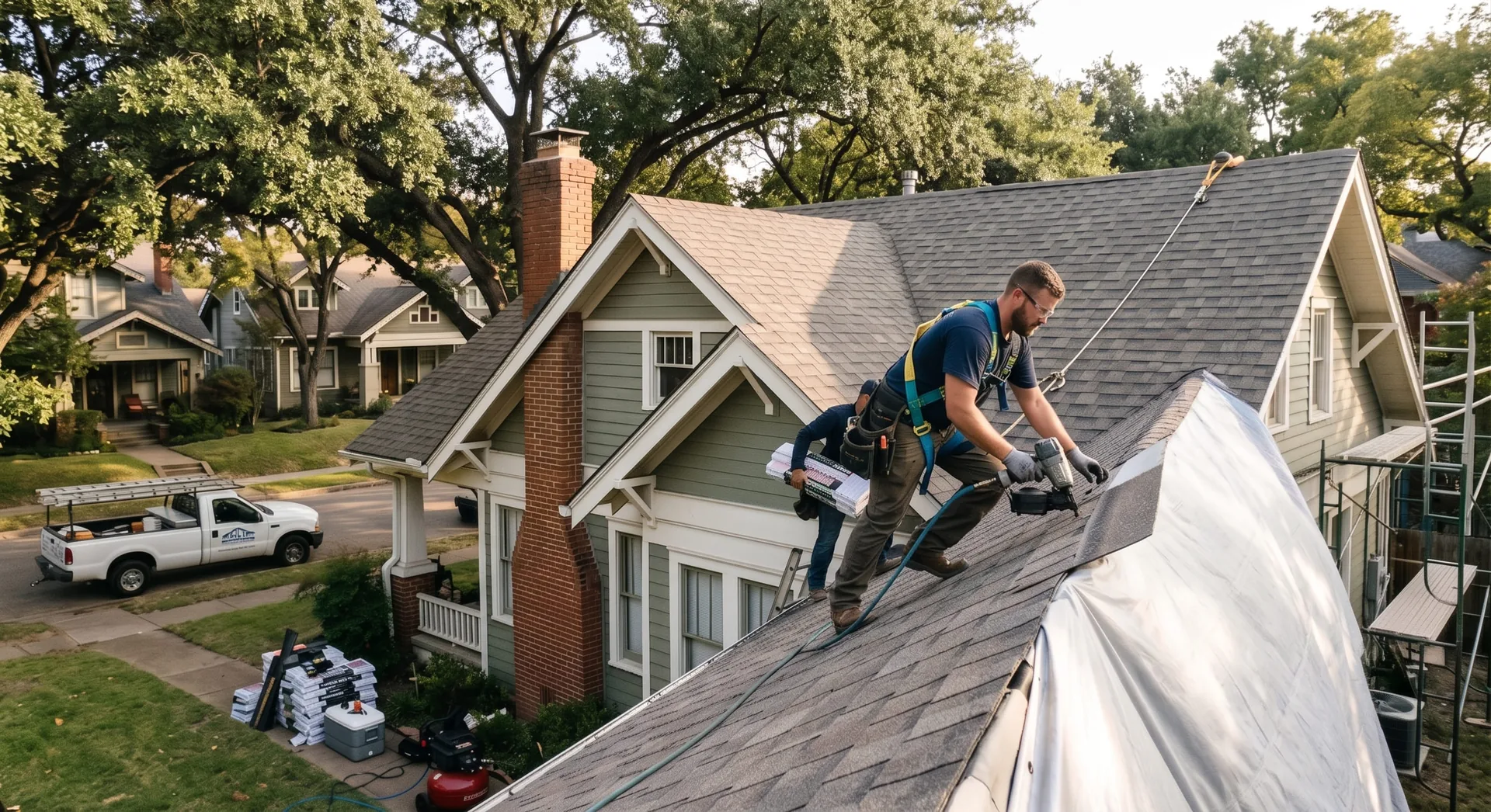
The reason is simple: the roofing process itself tends to damage gutters. Tear-off debris, shingles sliding down, ladders leaning against them, even toe boards for safety. All of it puts stress on the gutter system. Even if the runs still technically fit after the roof is complete, dents, bends, and pulled fasteners often leave them compromised.
The Drip Edge Problem
Modern building codes, including Dallas requirements, call for new, code-compliant drip edge to be installed with every roof replacement. But in many homes, the existing gutter fasteners run directly through the old drip edge. That means the gutters literally block the ability to remove and replace the drip edge. In those cases, gutter removal is not optional. It is required just to perform the roof replacement correctly. For more detail, see our post about drip edge.
Mitered Corners Cannot Be Put Back
Gutters are custom-sized to the house, and the corners are sealed and riveted together. Once a mitered corner is damaged, it cannot be put back the same way. Cutting out the damaged section leaves the gutter too short for the run, which means it will not fit the home anymore. At that point, replacement is not optional. It is required.
What the Code Actually Says
Insurance carriers often write line items that say “detach and reset gutters.” That might look good on paper, but in real-world construction it just does not happen. The International Residential Code (IRC R903.4) requires water to be directed away from the home without leaks, and patched-up systems do not meet that standard. The SMACNA (Sheet Metal and Air Conditioning Contractors’ National Association) guidelines, which are the sheet metal industry’s authority, make clear that gutters must be continuous, properly sized, and watertight. Once corners or runs are damaged, they are no longer compliant.
When Gutters Have to Be Replaced
- Steep roof pitches. The roofing process itself damages the gutter line.
- Tall rooflines. More debris, more impact, more stress.
- Drip edge replacement. Old fasteners through the drip edge make removal unavoidable.
- Mitered corners. Once bent or cut, they cannot be reused.
- Custom sizing. Any shortening means the gutter will not fit.
- Code and standards compliance. Both IRC and SMACNA call for watertight, functional systems, not patched ones.
How Bert Roofing Approaches It
We do not replace gutters just for the sake of it. If your home has a low slope and the gutters are still in excellent shape, we can often leave them alone. But for most steep-slope homes in Dallas, replacement is the right call. It ensures that your roof and gutter system work together as they should, keeping water away from your foundation, siding, and landscaping for years to come.
Serving Dallas neighborhoods like Lake Highlands, Lakewood, the Park Cities, and Preston Hollow, Bert Roofing has decades of experience making sure your gutters and roof work together the right way.