Introduction
For homeowners in Dallas and North Texas struggling with timing when it comes to roof replacement. Replace a roof too early and you waste good material. Wait too long and you risk interior damage that costs far more than the roof itself. The challenge is that, like many long-term decisions, there is uncertainty.
A useful analogy is financial planning. In theory, the perfect plan would have you spend your very last dollar on the day you die. In reality, that’s impossible—because no one knows that day in advance. Roofs work the same way. You are making a decision under uncertainty, trying to avoid both premature replacement and preventable damage.
Roof age is often treated as a hard rule, but it’s an unreliable metric by itself. Fifteen years is commonly cited because mortgage companies and insurance carriers often use it as a benchmark, not because something magical happens at year fifteen. We’ve written elsewhere about this misconception. Many homeowners also assume insurance will always replace a roof. That is simply not true. Insurance exists as a safety net for covered damage, not as a guaranteed replacement program.
A good roofer should help you navigate this uncertainty, not exploit it. In many cases, you won’t need a new roof at all. Sometimes you’ll need nothing. Sometimes a targeted repair is the correct answer. The goal of this guide is to help you understand how to make that decision intelligently, before urgency or fear forces it for you.
Why This Is a Harder Question Than It Seems
North Texas does get a significant amount of hail, but that hail is highly sporadic. Even in years with multiple storms, most homes will not experience meaningful hail damage. In reality, the majority of roof deterioration comes from normal aging—primarily long-term exposure to ultraviolet radiation from the sun, not from any single storm event.
Another complicating factor is that roofing materials do not age uniformly. Shingles wear at different rates from brand to brand, and even within the same manufacturer there are multiple product lines with very different performance characteristics. Two roofs of the same age can look and perform very differently depending on the shingle type, installation quality, ventilation, and exposure.
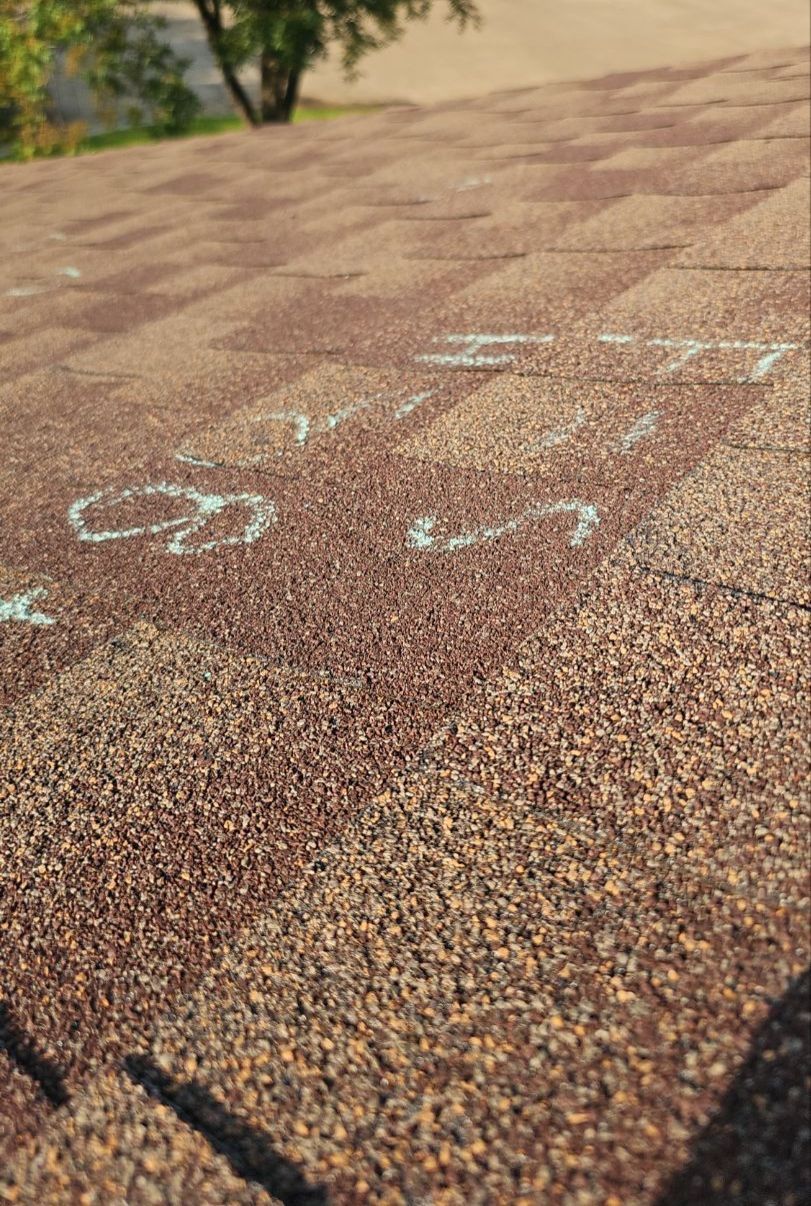
When wear or damage does occur, it’s also critical to understand the distinction between cosmetic and functional issues. Cosmetic damage may affect appearance but not performance. Functional damage compromises the roof’s ability to shed water and protect the structure. The difference matters, yet it is often poorly explained—or intentionally blurred.
This is where homeowners face real risk. The roofing industry attracts a large number of inexperienced companies and commission-driven sales representatives, especially after storms. Many lack the experience to accurately evaluate damage, yet they are quick to recommend full replacement. When multiple people with varying levels of expertise inspect the same roof, the situation can quickly become confusing.
Unsolicited door knocking adds another layer of risk. Inviting someone onto your roof simply because they showed up after a storm often leads to rushed conclusions and unnecessary pressure. A roof evaluation should bring clarity, not urgency.
Signs You Probably Do Not Need a New Roof
One of the most common concerns homeowners notice is the loss of aggregate, or granules, from shingles. This is normal. All asphalt shingles shed granules over time, and seeing some granules in gutters or at the bottom of downspouts—especially after a heavy rain—is not, by itself, a cause for alarm. In fact, new roofs often shed a noticeable amount early on, and granule loss continues gradually throughout the roof’s life cycle.
Flashing issues and sealant failures are also relatively common and do not automatically indicate the need for a full replacement. While a roof is largely maintenance-free, it is not maintenance-proof. Like most components of a home, some attention is required over time. Very little is typically needed in the first ten years, but beyond that point, minor repairs can often extend the life of a roof well into the mid-to-late teens.
Another positive indicator is clean decking with no signs of moisture intrusion. If the roof structure beneath the shingles is dry and intact, that strongly suggests the roof is still performing its primary function.
Minor wind damage, such as an isolated missing or creased shingle, is also frequently repairable. These situations should be evaluated by a qualified professional, but they do not usually justify replacing an entire roof on their own.
Signs You Should Take the Roof Seriously
General wear and tear is the first indicator that a roof deserves closer attention. One of the most telling signs is soft decking. Homeowners should not attempt to walk their roofs, but a proper inspection can identify areas where the decking has begun to lose structural integrity.
Chronic leaks are another warning sign. Repeated water intrusion often indicates a system-level problem rather than an isolated failure. That said, not all leaks originate from the roof itself. Siding, masonry, flashing, or penetrations can also be responsible, which is why diagnosis matters more than assumptions.
As shingles age, they gradually lose flexibility and become brittle. Once this happens, repairs become difficult or impossible. Shingles that crack or break when handled can no longer be reliably removed and replaced, which limits repair options and pushes the roof closer to full replacement.
Attic ventilation plays a significant role in this process. Poor ventilation accelerates heat buildup, which in turn speeds up shingle aging and increases brittleness. Two roofs of the same age can perform very differently depending on how well heat and moisture are managed in the attic.
Finally, aging does not occur in a linear fashion. Roofs tend to degrade exponentially as they approach the end of their service life. The difference between year fourteen and year fifteen is often far greater than the difference between year four and year five. As a roof enters this later stage, North Texas’s volatile weather patterns become far more consequential, and the margin for error narrows quickly.
The Dallas Insurance Reality (No Cheerleading)
Homeowners insurance exists to cover sudden, out-of-the-ordinary events, such as hail or wind. It does not exist to pay for normal wear and tear. That distinction is central to understanding why many roof claims are denied or partially approved.
Insurance also focuses on functional damage, not cosmetic issues. A shingle that looks bruised but still sheds water may not qualify for coverage. This is one of the biggest points of confusion for homeowners, particularly in North Texas, where hail is common but true functional damage is far less frequent.
One of the most common mistakes homeowners make is assuming that if a neighbor’s roof was replaced, theirs should be as well. We refer to this as “neighbor-itis.” Each claim is supposed to be evaluated on its own merits, based on the specific condition of that roof, not proximity or timing. In theory, insurance claims are objective. In practice, they are often subjective.
Outcomes can vary significantly from one insurance company to another, and even from one adjuster to another within the same company. This variability is frustrating, but it is a reality of the system.
Filing a claim also carries risk. A weak claim—one that results in damage well below the deductible—can still be recorded. Multiple claims, even small ones, may impact future insurability or premiums. This is why filing a claim simply to “see what happens” can be detrimental.
As a general rule of thumb, homeowners should consider the following before making a claim:
- There should be a clear, recent storm event
- Damage should be plausibly functional, not purely cosmetic
- The estimated scope should reasonably exceed the deductible
- The roof should be professionally evaluated before a claim is filed
Insurance can be an important safety net, but it is not an automatic solution. Used appropriately, it protects homeowners. Used casually, it can create long-term problems that outweigh any short-term benefit.
The Three Legitimate Paths Forward
There are only three legitimate ways to move forward with a roof that raises questions. Each has a place, depending on condition, risk tolerance, and time horizon.
Monitor
The lowest-cost option is to monitor the situation. This involves having a qualified professional inspect the roof, document its condition, and establish a baseline. Monitoring is appropriate when the roof is performing its function and there are no signs of active failure. Documentation also creates a reference point for future comparisons if conditions change.
Repair
Repair typically falls in the middle and is often the best option. A proper evaluation can identify weak areas—such as localized wind damage, flashing issues, or sealant failures—that can be addressed without replacing the entire system. When done correctly, targeted repairs can extend the usable life of a roof and delay replacement without materially increasing risk.
Replace
Replacement is the most definitive option. It removes uncertainty by taking future unknowns off the table entirely. This path carries the least performance risk but comes at the highest cost. It is often chosen when the roof is near the end of its service life, repairs are no longer viable, or the homeowner values certainty over incremental cost savings.
No single option is universally “right.” The correct path depends on the roof’s condition, the homeowner’s risk tolerance, and how long they intend to own the property. A proper evaluation should present these options clearly, without pressure to default to the most expensive solution.
Common Mistakes Dallas Homeowners Make
Choosing based on price alone
This is the most common mistake. Roofing prices can vary widely, but the shingle itself is only one component of a complete roof system. Starter shingles, ridge shingles, underlayment, valley protection, flashing details, and ventilation all matter. It is common for a contractor to offer a premium shingle while quietly cutting costs on accessories and installation details. That approach often looks good on paper and performs poorly over time.
Confusing confidence with competence
Much of the roofing industry operates on commission-only sales. Strong personalities, confidence, and salesmanship can be effective tools, but they are not substitutes for technical competence. A good roofer needs to understand building science, product limitations, and installation details—not just how to close a deal. Confidence can sell a roof; competence determines how it performs.
Allowing urgency to drive the decision
Creating urgency is a common sales tactic. Even when hail has legitimately shortened a roof’s life, it is unlikely that the roof will fail overnight. Most situations allow time for evaluation, research, and contractor selection. Homeowners rarely benefit from making a rushed decision with the first person who knocks on the door.
Overestimating warranties
Warranties are widely misunderstood. Most “lifetime” shingle warranties apply to the material itself, not the workmanship. They are also limited, prorated, and highly conditional. Workmanship is what determines whether a roof performs correctly, and product warranties do not cover poor installation. The quality of the installer matters far more than the wording on a brochure.
What a Real Roof Evaluation Should Include
A proper roof evaluation should be systematic, documented, and transparent. When conditions allow, it should begin with an on-roof inspection. Not all roofs are safely accessible—steep pitches, height, or surface conditions can limit physical access—but when access is possible, it provides the most accurate assessment of shingle condition, flashing details, and penetrations.
An evaluation should also include an attic inspection, with specific attention paid to the decking. Signs of moisture intrusion, staining, or deterioration beneath the roof surface often reveal issues that are not visible from above and are critical in determining whether a roof is still performing its primary function.
Ventilation review is another essential component. Poor attic ventilation accelerates shingle aging, increases brittleness, and contributes to premature failure. Two roofs of the same age can perform very differently depending on how heat and moisture are managed inside the attic space.
Photo documentation matters. At Bert Roofing, properties are documented using CompanyCam, which geotags and timestamps all photographs. This creates an objective visual record of conditions at the time of inspection and eliminates ambiguity about what was observed and when.
Finally, a real evaluation should include written annotations, not just images or a price. Clear explanations of findings—what matters, what does not, and why—help homeowners understand the condition of their roof and make informed decisions without pressure.
Where Bert Roofing Fits In
Bert Roofing’s role is simple: help homeowners understand what they are actually dealing with and what their real options are. That means telling you when a roof does not need to be replaced, when a repair makes sense, and when replacement is the responsible choice.
We are a Roofing Contractors Association of Texas (RCAT) Certified Roofing Contractor, which reflects a commitment to technical standards, continuing education, and ethical practices. Certification matters because roofing decisions carry long-term consequences, and not all contractors approach evaluations with the same level of care or training.
Bert Roofing has been serving the Dallas area since 1988. Longevity in this industry is not accidental. It requires consistent workmanship, conservative advice, and a willingness to prioritize long-term outcomes over short-term sales.
If you are unsure where your roof truly stands, a proper evaluation can bring clarity. Not urgency. Not pressure. Just information that allows you to make the right decision for your home, your timeline, and your risk tolerance.
That is where we can help.