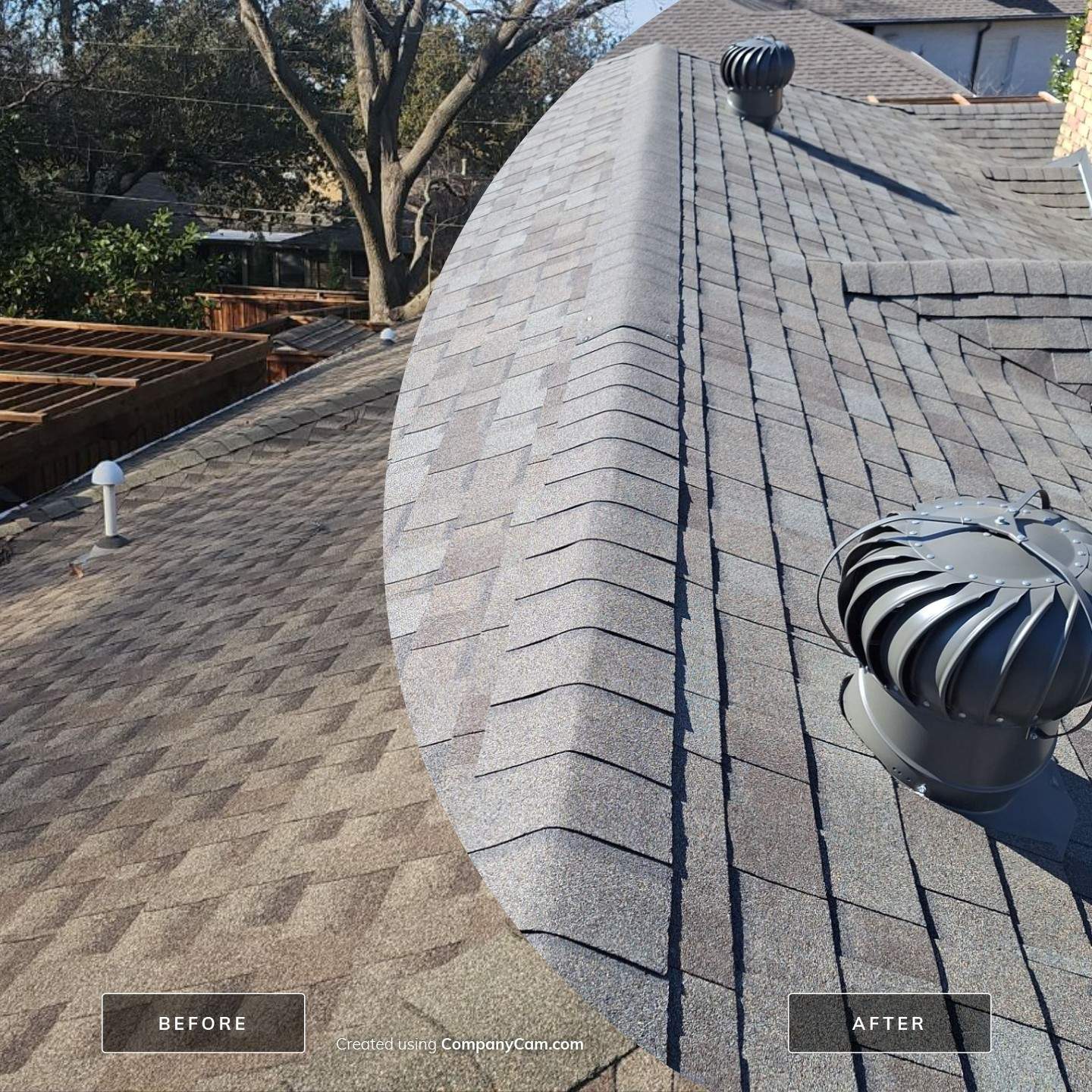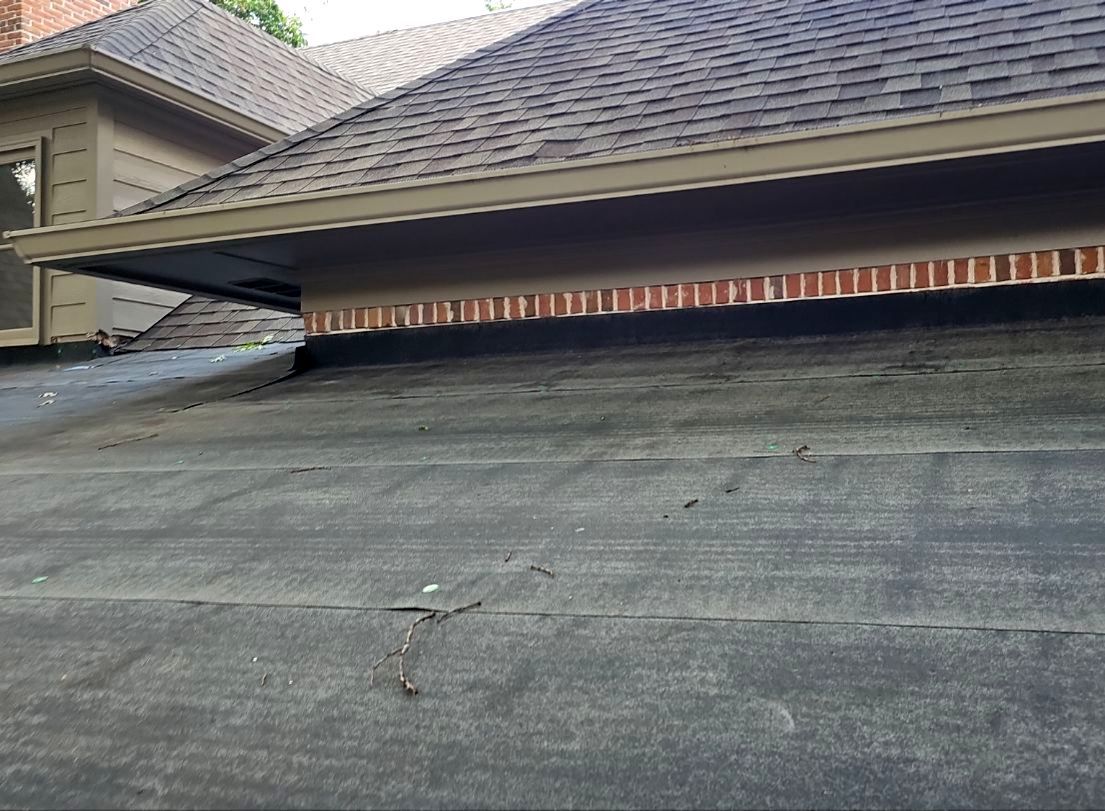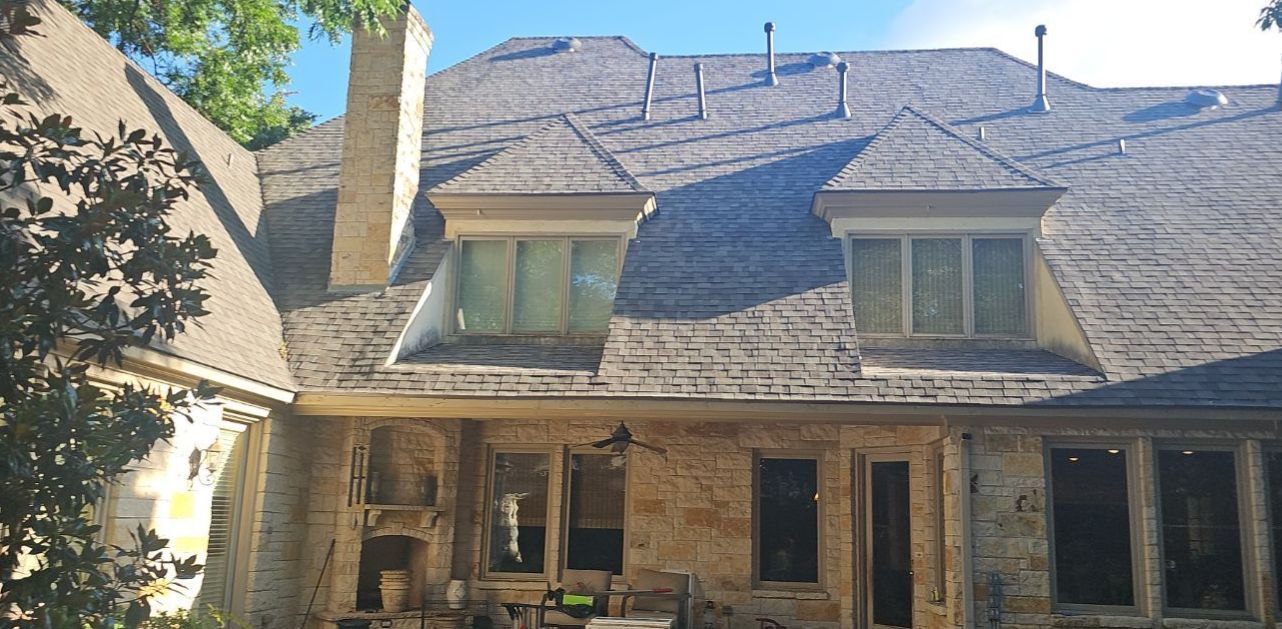
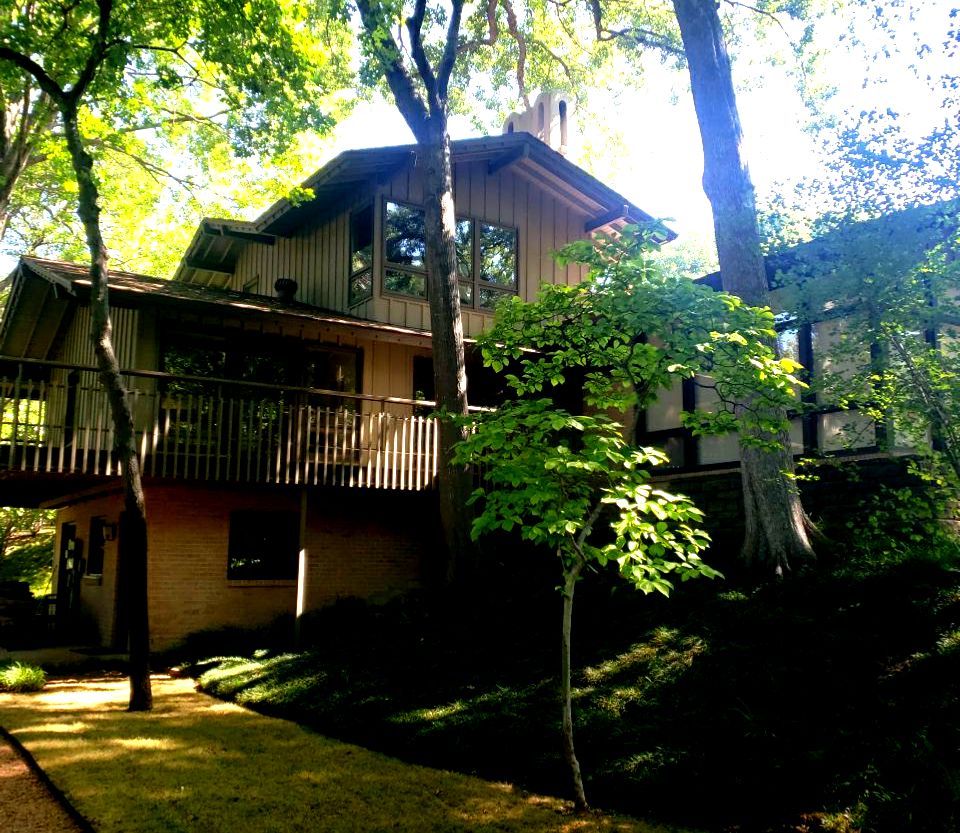
This Lakewood roof replacement was on Alexander Drive near Sperry Street, about a block from Lakewood Elementary in Dallas 75214.
It is one of those properties that is difficult to describe without seeing it. The house sits on a large wooded lot along a creek, surrounded by mature trees and heavy vegetation. Even by Lakewood standards, it feels secluded. It is the kind of setting that still looks like old Dallas rather than something built on a scraped lot.
The house itself is also unusual.
Built in the mid-1960s, it falls somewhere between mid-century modern and what has sometimes been described as soft contemporary architecture. It is not a Frank Lloyd Wright house, but the influence of the organic-modern school is fairly obvious. The house is horizontal rather than vertical, with broad roof overhangs, low rooflines, large areas of glass and several different wings that seem to grow out of the wooded lot.
Instead of treating the trees and creek as obstacles, the house was designed around them.
That is part of what makes the property interesting. It is also part of what makes the roof considerably more complicated than it first appears.
An Old Roof Does Not Automatically Mean an Insurance Claim
The reason we became involved was somewhat different from the typical storm-damage roofing job.
The roof was simply getting old.
The homeowner had also received notice from the insurance carrier that the roof needed to be replaced or coverage could be affected. We are seeing more of this.
Insurance companies have become much more aggressive about managing the age and condition of the roofs they insure. In some cases, the homeowner receives a letter requiring replacement within a certain period of time. In other cases, the carrier will renew the policy but change the roof coverage or increase the deductible. Some carriers simply decide they no longer want the risk.
The underlying economics are not difficult to understand.
A twenty-year-old asphalt roof is far more likely to produce a claim than a five-year-old roof. Even if the roof is not leaking today, the carrier knows that hail, wind or ordinary deterioration may create a loss tomorrow.
This roof appears to have reached that point.
There had been significant hail in the Lakewood area years earlier, but the roof was relatively new at that time. By the time we inspected it later, its principal problem was age rather than obvious storm damage.
A claim was apparently made, but it was not approved.
That distinction is important.
Sometimes Filing a Roof Claim Is a Bad Idea
There is a tendency in the roofing business to treat almost every older roof as a potential insurance claim.
That is not always good advice.
If a roof is genuinely damaged by hail or wind, the homeowner has every right to make a legitimate claim. That is what property insurance is for.
But an old roof is not necessarily a damaged roof.
If there is no reasonably identifiable storm damage, asking the insurance company to inspect an older roof can sometimes create more problems than it solves.
Once the carrier looks at the roof, they know exactly what they have.
A contractor who is primarily interested in generating insurance claims does not have much downside. If the claim is denied, the contractor moves on to the next lead.
The homeowner is the one who still owns the roof and has the relationship with the insurance company.
That does not mean homeowners should be afraid to make legitimate claims. It means the decision should be based on actual damage rather than the simple fact that the roof is old.
In this case, the ultimate problem was not getting an insurance company to buy the homeowner a roof. The problem was maintaining insurability on a house with an aging roof.
The practical answer was replacement.
A Very Lakewood House
The architecture made the project more interesting than a typical residential reroof.
The house was built in the 1960s and has many of the characteristics associated with mid-century organic architecture.
There are wide overhangs, horizontal roof planes, clerestory-type windows, natural materials and large areas of glass. The house follows the contours of the property rather than sitting as one simple rectangular structure.
That produces a roof with a lot going on.
There are multiple elevations, intersecting roof sections, walls rising through roof planes, valleys, chimney transitions and numerous plumbing and ventilation penetrations.
From the ground, much of the roof is hidden by trees.
From the roof, it becomes apparent how large and complex the structure actually is.
That architecture works beautifully on a wooded creek lot. It also means the details matter when the roof is replaced.
Nearly 55 Squares of Roofing
The existing roof measured roughly 50 squares before waste, with approximately 55 squares of laminated architectural shingles required for replacement.
That is a substantial roof.
For comparison, many average Dallas houses are somewhere around 25 to 35 squares.
The size is somewhat deceptive because the house is spread across a series of relatively low roof planes rather than one large steep roof.
The old shingles and roofing accessories were removed so that the new roofing system could be installed from the deck up.
We installed GAF Timberline HDZ architectural shingles in Shakewood.
Shakewood is a fairly traditional brown blend and worked particularly well with this house. Between the mature trees, stained wood, masonry and muted exterior colors, a dramatically darker or more modern roof color could easily have overwhelmed the architecture.
The objective was not to make the roof stand out.
It was to make it look as though it belonged on the house.
Roofing Details Matter More on Complicated Houses
The shingles are obviously the most visible part of a new roof, but shingles are rarely the most difficult part of a reroof.
The difficult areas are normally where the roof changes direction or intersects something else.
This house had plenty of those.
The project included hundreds of feet of drip edge, more than 200 feet of ridge and hip work, a large chimney, multiple wall transitions and nine plumbing vent penetrations.
There were also several ventilation components, including four turbine vents.
Each penetration through a roof is a potential leak point if it is not properly flashed.
The same applies where a roof meets a wall.
Those areas depend on flashing rather than caulk to keep water out.
Caulk is useful as a secondary sealant. It should not be the primary waterproofing system.
On an older architecturally complicated house, it is common to find flashing details that have been modified during previous roofing projects. Some are good. Some are not.
One advantage of completely removing the old roof is that those details can be evaluated instead of simply being covered again.
Trees Are Beautiful. Roofers Have a Different Perspective.
The trees are one of the best features of this property.
They are also one of the reasons the roof requires more attention than a roof sitting in an open subdivision.
Heavy tree cover creates shade, holds moisture and deposits leaves, acorns, twigs and organic debris on the roof.
That does not mean trees are bad for a roof. I would certainly not suggest removing mature Lakewood trees merely to make life easier on the shingles.
It does mean maintenance matters.
Valleys and low areas should be kept reasonably clean. Limbs should not continually scrape across the shingles. Gutters and drainage paths need to stay open.
A roof under heavy tree cover also ages differently from one exposed to full Dallas sun all day.
Some areas receive very little ultraviolet exposure. Other roof sections may receive intense afternoon sun.
The result can be uneven aging across different parts of the same roof.
That was particularly relevant on this house because the roof winds its way through and around a very mature tree canopy.
Roof Replacement as an Insurance Requirement
The insurance side of this project may eventually become more common than the storm-claim side of roofing.
For years, Dallas roofing has been dominated by hail.
Storm comes through. Roof is damaged. Homeowner files a claim. Insurance company pays to replace the roof.
That still happens.
But insurance companies are paying much closer attention to roof age.
Some carriers no longer want to insure roofs beyond a certain age. Others may exclude cosmetic damage, change replacement-cost coverage to actual-cash-value coverage or impose substantially higher wind and hail deductibles.
The homeowner may never have had a roof leak.
The carrier may simply decide that the probability of a future loss is too high.
That creates an odd situation.
A perfectly serviceable roof can become an insurance problem before it becomes a water problem.
Homeowners frequently find out when they receive a nonrenewal notice, shop for another carrier or attempt to sell the house.
At that point, replacing the roof becomes less about repairing damage and more about protecting the overall insurability and marketability of the property.
The Better Question Is Why the Roof Needs Replacement
There are several legitimate reasons to replace a roof.
Storm damage is one.
Active leaks are another.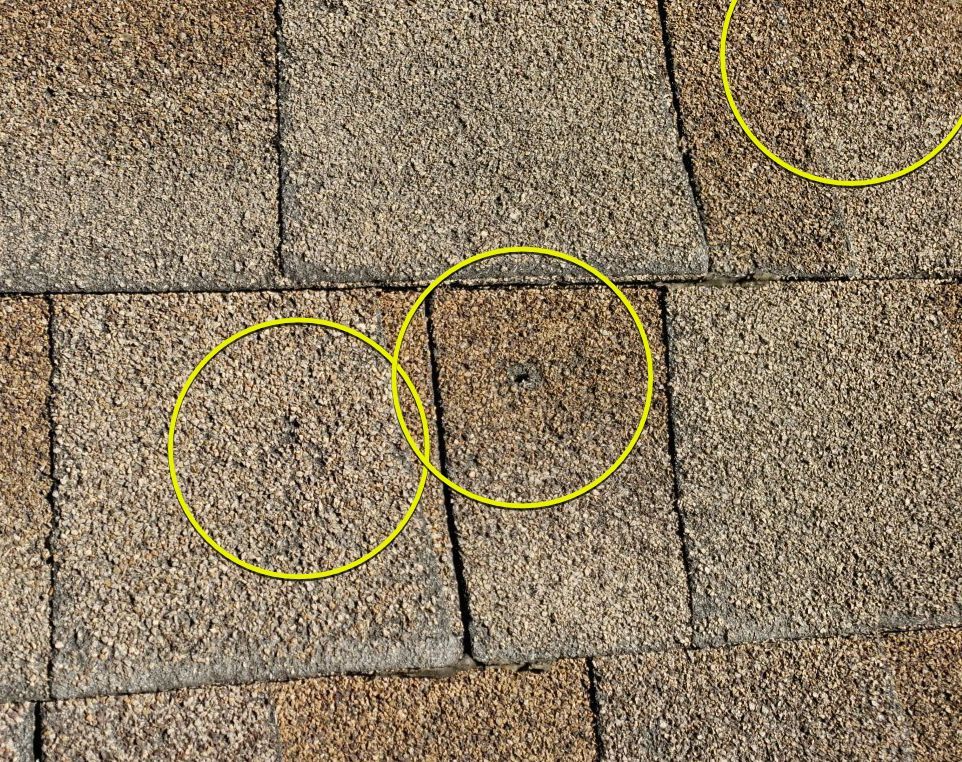
Sometimes the roof is simply worn out.
And increasingly, insurance availability is becoming another reason.
Those are very different situations, and they should not all be forced into the same insurance-claim model.
When we inspect an older roof, the useful question is not, “Can we get the insurance company to buy it?”
The useful question is, “What is actually wrong with the roof?”
Sometimes the answer is hail damage.
Sometimes the answer is a repair.
Sometimes the roof has several useful years left.
And sometimes, as with this Lakewood house, the roof has reached an age where replacement simply makes sense.
There is nothing particularly exciting about that answer.
It is just the correct one.
Roofing in Lakewood and Dallas 75214
Lakewood has some of the most varied housing stock in Dallas.
Within a relatively small area there are Tudors, Spanish and Mediterranean houses, traditional brick homes, mid-century houses, contemporary renovations and houses that are difficult to put into any single category.
The trees are mature. Lots are irregular. Many houses have been remodeled several times.
That makes roofing in Lakewood different from roofing a newer subdivision where twenty houses in a row may have essentially the same roof.
Older Dallas houses tend to have stories.
They have additions, unusual framing, old flashing details, chimneys that have been modified, decking from different periods and roofing systems that have evolved along with the house.
This Alexander Drive property was a particularly good example.
The finished roof is not the most interesting thing about the house.
It shouldn’t be.
On a property like this, a good roof should quietly protect the architecture underneath it and disappear into the overall design.
That was the goal here.