A roof does not have to be leaking to become an issue during a home sale.
That is one of the harder roof questions buyers face. A roof may still be functional. It may not show active failure. It may not require immediate replacement from a purely roofing standpoint.
But during a sale, the question changes.
The buyer is not only asking whether the roof works today. The buyer is also asking whether the roof will be insurable, whether the mortgage company will have concerns, and whether the buyer is about to inherit a major maintenance item after closing.
That is where an older but functional roof can become complicated.
A Recent Highland Park Roof Inspection During a Home Sale
We recently looked at an architectural asphalt composition shingle roof on a home being sold in West Highland Park. The property was west of the Dallas North Tollway and south of Mockingbird Lane.
A realtor we have worked with for years asked us to look at the roof for the buyer.
The roof was not an obvious failure. There were no signs of active roof failure. The roof was functional at the time of the inspection.
But it was also not a new roof.
Based on information from the seller, the roof was roughly 10 to 12 years old. It was reportedly replaced during a prior remodel and addition.
That age range creates one of the harder roof questions in a real estate sale.
It is old enough to raise questions.
It is young enough that replacement is not always clear-cut.
That gray area matters for buyers, especially in high-value Dallas neighborhoods like Highland Park, University Park, Preston Hollow, Lakewood, and established parts of East Dallas.
A Functional Roof Is Not Always a Simple Answer for a Buyer
For a homeowner who already lives in the house, this type of roof might not create much urgency.
If there are no leaks and no obvious active failure, the practical advice may be to monitor it and address specific repair items as needed.
A buyer looks at the same roof differently.
The buyer is not just asking, “Is it leaking today?”
The buyer is asking:
- Will this roof need replacement soon?
- Will my insurance company accept it?
- Will my mortgage company have concerns?
- Am I inheriting a major maintenance item right after closing?
- Should this be addressed before the sale is final?
Those are different questions.
A roofer can evaluate roof condition. A roofer can point out wear, storm damage, flashing issues, repair items, and replacement cost.
But a roofer should be careful about deciding what a buyer should demand or what a seller should concede.
That is a real estate negotiation issue, not just a roofing issue.
Why a 10- to 12-Year-Old Roof Can Be Hard to Judge
A roof in this age range often falls into the middle.
It may still have useful life left.
It may also be far enough into its life cycle that a buyer should not ignore it.
That is the uncomfortable part. A buyer has to be comfortable with some uncertainty. If the buyer is not comfortable with that uncertainty, the issue becomes less about whether the roof is leaking today and more about what the buyer wants resolved before closing.
In this case, the roof showed age, but not active failure.
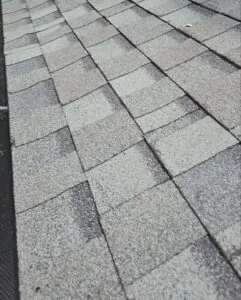
There were small signs of asphalt aging. These included minor surface fracturing, limited granule loss, and small blister-like areas. These signs do not automatically mean the roof is failing. They do show that the roof is no longer new.
A seasoned roofer can usually tell the difference.
A roof can be functional and still show age.
A roof can show age and still not require immediate replacement.
That is why absolute answers can be misleading.
Be Careful With Absolute Roof Opinions During a Sale
When a roof is in the middle of its expected life, buyers should be skeptical of overly certain answers.
“It absolutely has to be replaced” may overstate the condition.
“It is absolutely fine” may understate the buyer’s risk.
Neither answer may be accurate.
Roof opinions during a real estate sale can also be affected by incentives. A roofer who makes money replacing roofs may lean toward replacement. A roofer brought in by the seller may lean toward a less urgent answer. A roofer who works closely with a realtor may also feel pressure to keep the deal moving.
The better question is not who wins the argument.
The better question is whether the roof is functional, insurable, and likely to become a near-term cost for the buyer.
Roof Age Matters to Insurance Companies
Insurance is often the first practical question.
Before a buyer decides whether to demand a new roof, the buyer should find out whether the roof can be insured as-is. That can be a major hurdle.
Insurance carriers do not all follow the same rules. But roof age matters in Dallas. Many carriers become more cautious as asphalt shingle roofs get older. A roof approaching 15 years old can become harder to insure, even when it is not actively leaking.
That line can feel arbitrary. But the insurance concern is not arbitrary from the carrier’s standpoint.
Asphalt shingles become more brittle as they age. Dallas heat, UV exposure, storms, and normal weathering all take a toll. Older shingles are usually less flexible than newer shingles. That can make them more vulnerable to hail, wind, foot traffic, and repair disturbance.
A newer roof is generally a lower risk for an insurance carrier than an older roof.
That does not mean every 10- to 12-year-old roof is uninsurable. It does mean buyers should ask the insurance question early.
Dallas Heat and Sun Exposure Do Not Age Every Roof Slope the Same Way
Roof age is not just a calendar issue.
Sun exposure matters.
In Dallas, north-facing roof slopes often age more slowly because they receive less direct sun. South-facing slopes usually see more UV exposure. West-facing slopes can also age faster because they catch intense afternoon sun and heat. East-facing slopes may look better by comparison.
That means one roof slope can look better than another, even though the whole roof was installed at the same time.
This is one reason roof inspections require judgment. You are not just looking for leaks. You are looking at aging patterns, exposure, brittle shingles, granule loss, flashing condition, and whether the roof still appears serviceable.
Why This Comes Up in Highland Park and Other High-Value Dallas Neighborhoods
This inspection happened in West Highland Park, but the same issue comes up across high-value Dallas neighborhoods.
In areas like Highland Park, University Park, Preston Hollow, Lakewood, and parts of East Dallas, buyers are often not just asking whether the roof leaks today. They are asking whether they are about to inherit a major maintenance item.
That does not mean the seller is wrong to resist replacing a functional roof.
Most sellers do not want to replace a roof unless they have to. That is understandable. If the roof is not leaking and does not show active failure, a seller may see replacement as unnecessary.
The buyer sees a different risk.
The buyer is the one who will own the next leak, the next insurance renewal, the next storm, and the next replacement decision.
That difference in perspective is why older but functional roofs can become negotiation issues.
Repair Estimate vs Replacement Estimate
In a gray-area roof situation, it can be useful to separate specific repair items from full replacement cost.
A repair estimate addresses known maintenance items.
A replacement estimate gives the buyer a realistic number if they want to understand the cost of starting over with a new roof.
Those are not the same thing.
A repair estimate does not mean the entire roof has failed. A replacement estimate does not always mean the roof must be replaced immediately. They are tools for decision-making.
For a buyer, the practical choices are usually simple.
Accept the roof as part of the purchase.
Ask for specific repair items.
Or negotiate with replacement cost in mind.
None of those choices is automatically right. It depends on insurability, buyer risk tolerance, roof condition, and the economics of the sale.
What a Roofer Can and Cannot Honestly Tell You
A roofer can tell you what is visible on the roof.
A roofer can identify signs of age, wear, storm damage, installation problems, flashing concerns, and repair items.
A roofer can provide repair pricing or replacement pricing.
A roofer cannot honestly guarantee when a functional older roof will fail.
A roofer also should not decide how an insurance company, mortgage company, buyer, seller, or realtor will handle the roof during the sale.
That is why the phrase “functional today” matters.
It means the roof does not show active failure at the time it is evaluated. It does not mean the roof is new. It does not mean the buyer has no risk. It does not mean the roof will satisfy every insurance carrier or every lender.
It means the roof is working now, while still carrying the uncertainty that comes with age.
The Main Takeaway for Buyers
An older but functional roof does not always create a clear yes-or-no answer.
At roughly 10 to 12 years old, an architectural asphalt shingle roof may still have useful life left. It may also be close enough to future replacement that a buyer should think carefully about insurance, maintenance, and negotiation.
The most practical first step is to confirm whether the roof can be insured as-is.
After that, the buyer has to decide how much uncertainty they are willing to accept.
If the buyer is comfortable with the roof condition, the sale may move forward with limited roof work or no immediate replacement. If the buyer is not comfortable with that uncertainty, the roof may become a negotiation issue.
Bert Roofing has inspected, repaired, and replaced roofs in Dallas since 1988. We work throughout Highland Park, University Park, Preston Hollow, Lakewood, Lake Highlands, and East Dallas. For buyers, sellers, and realtors, our goal is to separate roof condition from sales pressure and provide practical roofing information that helps people make better decisions.