Why I’m Writing About Xactimate Errors
I see the same Xactimate mistakes over and over. This post is not about your insurance policy. Bert Roofing is a contractor, not a public adjuster. Coverage questions are outside our scope. My goal is simple: help you spot and write a proper roof estimate. We won’t hit every situation. We will hit the common errors and omissions that cost money when a storm occurs. Most low estimates share one trait: missing line items. Things get skipped. Let’s fix that.
Where Xactimate Roof Estimates Go Wrong
If-Incurred Items: Easy to Miss, Expensive to Forget
An if-incurred item is paid only if you actually do the work. You’ll often see a $0 placeholder in the estimate. Payment follows proof of completion on the final invoice. Typical examples include permits, double underlayment on low slopes, extra tear-off layers, small deck repairs, crane time, and dumpster overages. These get missed on final billing more than you think.
How to capture them:
- Flag all $0 lines before production.
- Train crews to note triggers like low slope and hidden layers.
- Collect clear photos.
- Add the cost when you incur it.
- Audit the invoice against every $0 line.
Debris Removal: Dumpster vs. Haul-Off
In DFW, most roofers haul their own debris. Dumpsters are not the local norm. If you price “tear off only” and add a dumpster, the math can look cheaper. Often, it isn’t.
Real example, about 45 squares:
- Tear off with haul-off: $3,060.
- Tear off only: $2,077.
- One 20-yard dumpster: $456.
- Combined: $2,533. It looks $500+ lower than haul-off.
But a 20-yard dumpster often includes about 4 tons. Xactimate Components showed about 6.43 tons for a job this size. You’ll need two pulls. Now you’re at $2,989 before any overages. The “savings” just evaporated.
What to write:
- If you self-haul, use tear off + haul-off as one line.
- If you use dumpsters, match the count to the expected weight.
- Add overage or a second pull when needed.
- Keep the language neutral and accurate.
Different trades don’t automatically share dumpsters. When trades are priced separately and no general-contractor overhead and profit is being applied, do not assume one trade’s debris-removal allowance covers another trade. Gutters often get replaced with the roof, and that adds debris. Each trade should have appropriate debris removal reflected in the scope.
Ridge Caps: Enhanced vs. Cut 3-Tab
Most homes use one of two ridge options:
- Cut 3-tab ridge, made from strip shingles.
- Enhanced ridge, like GAF Z-Ridge, TimberTex, or Seal-A-Ridge.
Both can be correct when installed per specifications. They look different and price differently. Enhanced ridge typically costs about $3 per linear foot more than cut 3-tab. At 300 LF, that’s about $900 you’ll miss if you default to cut 3-tab.
What to write:
- Add a distinct enhanced ridge line when present.
- Enter the actual LF of hips and ridges.
- Note the product, such as Z-Ridge, TimberTex, or Seal-A-Ridge.
- Attach a label photo for proof.
- Don’t bury ridge in “waste.”
Manufacturer references: See GAF’s product and installation guides for Z-Ridge, TimberTex, and Seal-A-Ridge.
Drip Edge: Replace Eaves and Rakes, and Match Code
Many estimates replace only rake metal. That is a common error. Replace eaves and rakes to meet applicable code and manufacturer guidance.
Why “rakes only” is wrong:
- Underlayment layering: at eaves it goes over the metal; at rakes it goes under.
- Gutters: new fasteners rarely hit old holes. Leaving old eave metal creates a perforated mess.
- Size: the IRC requires drip edge at eaves and rakes, with specific overlaps and leg dimensions. A 1.5-inch × 1.5-inch profile usually does not meet the 2-inch roof-deck leg requirement. Use a profile that meets the applicable code requirement.
Code reference: IRC R905.2.8.5 addresses drip edge at eaves and rakes, overlap, fastening, and underlayment placement.
GAF technical note: GAF strongly recommends drip edge at eaves and rakes and provides guidance on shingle overhang. See GAF Technical Advisory Bulletin R-141.
What to write:
- Separate lines: replace drip edge – eaves and replace drip edge – rakes.
- Specify profile, size, color, and minimum 0.019-inch thickness where appropriate.
- Note that gutter replacement may require new eave metal.
- Reference the applicable IRC section in your line note.
Deep dive: The Asphalt Roofing Manufacturers Association has a current best-practice sheet on drip edge layering at eaves and rakes.
Further reading: See our own write-up, Drip Edge: The Most Common Roof Mistake.
Chimneys and Crickets
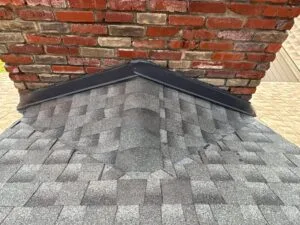
Chimney work is often missing. That is a plain omission. A typical chimney flashing scope is a meaningful ticket.
What to include:
- Remove old apron and step flashing.
- Install new apron and step flashing.
- Seal and reglet as needed.
- Add leak barrier and underlayment per manufacturer guidance.
Crickets for wide chimneys: A chimney more than 30 inches wide, measured parallel to the ridgeline, generally requires a cricket when it does not intersect the ridgeline. Add it to the scope or mark it if-incurred pending field verification. See IRC R1003.20.
Helpful reference: GAF’s Steep-Slope Pro Field Guide includes chimney flashing and cricket details.
Lead Collars: Don’t Detach and Reset
Lead is very soft. Once you bend a lead collar, it rarely returns to form. Detach-and-reset is poor practice on reroofs.
Best practice:
- Remove and replace the plumbing vent flashing.
- Use a new lead collar or a purpose-built pipe boot.
- Follow the manufacturer’s installation instructions and photo-document the work.
For reference, see GAF’s Master Flow pipe boot installation instructions and pipe flashing guidance.
Starter and Ridge Aren’t Included in Waste
A roof has three shingle types: field, starter, and hip/ridge. Xactimate prices them separately. Do not bury starter or ridge in field “waste.” You will under-scope the job and lose money.
The math:
- Starter vs. 3-tab used as starter: about $160 vs. $106 per bundle. Delta: $54 per roughly 75 LF.
- Ridge vs. 3-tab used as ridge: about $178 vs. $106 per bundle. Delta: $72 per roughly 33 LF.
A typical home with 3 starter bundles and 9 ridge bundles loses about $810 if you lump them together.
What to write:
- Add three lines: field shingles, starter, and hip/ridge.
- Enter actual LF for starter and ridge.
- Note the GAF product if upgraded ridge is present.
- Keep “waste” for field shingles only.
Manufacturer references: See GAF’s Pro-Start and WeatherBlocker starter instructions, along with the TimberTex and Seal-A-Ridge installation instructions.
Xactimate vs. Symbility: Watch the Language
Xactimate is still widely used. Symbility is another estimating platform used in property claims. Used correctly, the results can be similar. Used loosely, errors slip in.
Where mistakes hide:
- Different line names and defaults.
- Unit confusion: LF, EA, and SQ.
- Waste logic tied to the wrong component.
- Tear-off lines that don’t include haul-off.
- Steep and height charges that don’t translate cleanly.
How to protect yourself:
- Build a crosswalk of your top roofing lines.
- Lock the units for each line.
- Add clear line notes on scope and materials.
- Attach photos and labels.
- Audit against your Xactimate baseline before you send.
Final Xactimate Roof Estimate Check
This guide is not everything. It covers the common mistakes I see most. Write scopes that match applicable code and manufacturer instructions. Train your team to capture if-incurred items. Price starter and ridge separately. Replace drip edge at eaves and rakes. Make sure debris-removal allowances actually match the work being performed.
One more note for Texas homeowners: Texas does not allow a roofer or contractor to act as a public insurance adjuster on a claim if the contractor is also doing the work. We do not give policy advice. We give software and scope advice so your estimate reflects the actual build. See the Texas Insurance Code and the Texas Department of Insurance guidance.
Got a question about your own roof? Free inspection, written estimate, no high-pressure sales.